
How to Build Production-Grade Agentic Workflows with GraphBit Using Deterministic Tools, Validated Execution Graphs, and Optional LLM Orchestration


In this tutorial, we build an end-to-end, production-style agentic workflow using GraphBit that demonstrates how graph-structured execution, tool calling, and optional LLM-driven agents can coexist in a single system. We start by initializing and inspecting the GraphBit runtime, then define a realistic customer-support ticket domain with typed data structures and deterministic, offline-executable tools. We show how these tools can be composed into a reliable, rule-based pipeline for classification, routing, and response drafting, and then elevate that same logic into a validated GraphBit workflow in which agent nodes orchestrate tool usage via a directed graph. Throughout the tutorial, we keep the system running in offline mode while enabling seamless promotion to online execution by simply providing an LLM configuration, illustrating how GraphBit supports the gradual adoption of agentic intelligence without sacrificing reproducibility or operational control. Check out the Full Codes here.
import os
import time
import json
import random
from dataclasses import dataclass
from typing import Dict, Any, List, Optional
import numpy as np
from rich import print as rprint
from rich.panel import Panel
from rich.table import Table
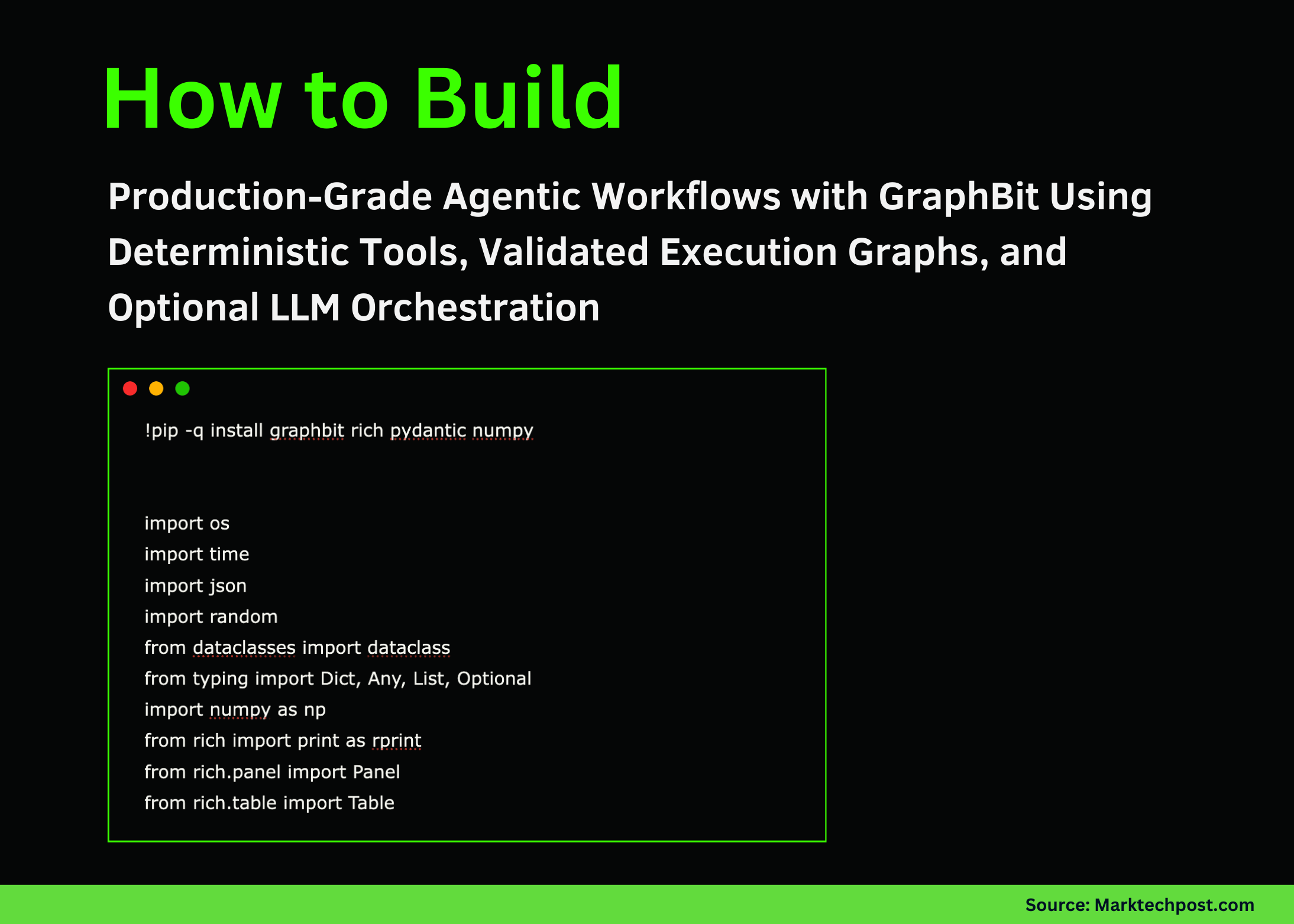
We begin by installing all required dependencies and importing the core Python, numerical, and visualization libraries needed for the tutorial. We set up the runtime environment so the notebook remains self-contained and reproducible on Google Colab. Check out the Full Codes here.
from graphbit import Workflow, Node, Executor, LlmConfig
from graphbit import tool, ToolExecutor, ExecutorConfig
from graphbit import get_tool_registry, clear_tools
configure_runtime(worker_threads=4, max_blocking_threads=8, thread_stack_size_mb=2)
init(log_level=”warn”, enable_tracing=False, debug=False)
info = get_system_info()
health = health_check()
sys_table = Table(title=”System Info / Health”)
sys_table.add_column(“Key”, style=”bold”)
sys_table.add_column(“Value”)
for k in [“version”, “python_binding_version”, “cpu_count”, “runtime_worker_threads”, “runtime_initialized”, “build_target”, “build_profile”]:
sys_table.add_row(k, str(info.get(k)))
sys_table.add_row(“graphbit_version()”, str(version()))
sys_table.add_row(“overall_healthy”, str(health.get(“overall_healthy”)))
rprint(sys_table)
We initialize the GraphBit runtime and explicitly configure its execution parameters to control threading and resource usage. We then query system metadata and perform a health check to verify that the runtime is correctly initialized. Check out the Full Codes here.
class Ticket:
ticket_id: str
user_id: str
text: str
created_at: float
def make_tickets(n: int = 10) -> List[Ticket]:
seeds = [
“My card payment failed twice, what should I do?”,
“I want to cancel my subscription immediately.”,
“Your app crashes when I open the dashboard.”,
“Please update my email address on the account.”,
“Refund not received after 7 days.”,
“My delivery is delayed and tracking is stuck.”,
“I suspect fraudulent activity on my account.”,
“How can I change my billing cycle date?”,
“The website is very slow and times out.”,
“I forgot my password and cannot login.”,
“Chargeback process details please.”,
“Need invoice for last month’s payment.”
]
random.shuffle(seeds)
out = []
for i in range(n):
out.append(
Ticket(
ticket_id=f”T-{1000+i}”,
user_id=f”U-{random.randint(100,999)}”,
text=seeds[i % len(seeds)],
created_at=time.time() – random.randint(0, 7 * 24 * 3600),
)
)
return out
tickets = make_tickets(10)
rprint(Panel.fit(“\n”.join([f”- {t.ticket_id}: {t.text}” for t in tickets]), title=”Sample Tickets”))
We define a strongly typed data model for support tickets and generate a synthetic dataset that simulates realistic customer issues. We construct tickets with timestamps and identifiers to mirror production inputs. This dataset serves as the shared input across both offline and agent-driven pipelines. Check out the Full Codes here.
@tool(_description=”Classify a support ticket into a coarse category.”)
def classify_ticket(text: str) -> Dict[str, Any]:
t = text.lower()
if “fraud” in t or “fraudulent” in t:
return {“category”: “fraud”, “priority”: “p0”}
if “cancel” in t:
return {“category”: “cancellation”, “priority”: “p1”}
if “refund” in t or “chargeback” in t:
return {“category”: “refunds”, “priority”: “p1”}
if “password” in t or “login” in t:
return {“category”: “account_access”, “priority”: “p2”}
if “crash” in t or “slow” in t or “timeout” in t:
return {“category”: “bug”, “priority”: “p2”}
if “payment” in t or “billing” in t or “invoice” in t:
return {“category”: “billing”, “priority”: “p2”}
if “delivery” in t or “tracking” in t:
return {“category”: “delivery”, “priority”: “p3”}
return {“category”: “general”, “priority”: “p3″}
@tool(_description=”Route a ticket to a queue (returns queue id and SLA hours).”)
def route_ticket(category: str, priority: str) -> Dict[str, Any]:
queue_map = {
“fraud”: (“risk_ops”, 2),
“cancellation”: (“retention”, 8),
“refunds”: (“payments_ops”, 12),
“account_access”: (“identity”, 12),
“bug”: (“engineering_support”, 24),
“billing”: (“billing_support”, 24),
“delivery”: (“logistics_support”, 48),
“general”: (“support_general”, 48),
}
q, sla = queue_map.get(category, (“support_general”, 48))
if priority == “p0”:
sla = min(sla, 2)
elif priority == “p1”:
sla = min(sla, 8)
return {“queue”: q, “sla_hours”: sla}
@tool(_description=”Generate a playbook response based on category + priority.”)
def draft_response(category: str, priority: str, ticket_text: str) -> Dict[str, Any]:
templates = {
“fraud”: “We’ve temporarily secured your account. Please confirm last 3 transactions and reset credentials.”,
“cancellation”: “We can help cancel your subscription. Please confirm your plan and the effective date you want.”,
“refunds”: “We’re checking the refund status. Please share the order/payment reference and date.”,
“account_access”: “Let’s get you back in. Please use the password reset link; if blocked, we’ll verify identity.”,
“bug”: “Thanks for reporting. Please share device/browser + a screenshot; we’ll attempt reproduction.”,
“billing”: “We can help with billing. Please confirm the last 4 digits and the invoice period you need.”,
“delivery”: “We’re checking shipment status. Please share your tracking ID and delivery address PIN/ZIP.”,
“general”: “Thanks for reaching out.”
}
base = templates.get(category, templates[“general”])
tone = “urgent” if priority == “p0” else (“fast” if priority == “p1” else “standard”)
return {
“tone”: tone,
“message”: f”{base}\n\nContext we received: ‘{ticket_text}'”,
“next_steps”: [“request_missing_info”, “log_case”, “route_to_queue”]
}
registry = get_tool_registry()
tools_list = registry.list_tools() if hasattr(registry, “list_tools”) else []
rprint(Panel.fit(f”Registered tools: {tools_list}”, title=”Tool Registry”))
We register deterministic business tools for ticket classification, routing, and response drafting using GraphBit’s tool interface. We encode domain logic directly into these tools so they can be executed without any LLM dependency. This establishes a reliable, testable foundation for later agent orchestration. Check out the Full Codes here.
max_execution_time_ms=10_000,
max_tool_calls=50,
continue_on_error=False,
store_results=True,
enable_logging=False
)
tool_executor = ToolExecutor(config=tool_exec_cfg) if “config” in ToolExecutor.__init__.__code__.co_varnames else ToolExecutor()
def offline_triage(ticket: Ticket) -> Dict[str, Any]:
c = classify_ticket(ticket.text)
rt = route_ticket(c[“category”], c[“priority”])
dr = draft_response(c[“category”], c[“priority”], ticket.text)
return {
“ticket_id”: ticket.ticket_id,
“user_id”: ticket.user_id,
“category”: c[“category”],
“priority”: c[“priority”],
“queue”: rt[“queue”],
“sla_hours”: rt[“sla_hours”],
“draft”: dr[“message”],
“tone”: dr[“tone”],
“steps”: [
(“classify_ticket”, c),
(“route_ticket”, rt),
(“draft_response”, dr),
]
}
offline_results = [offline_triage(t) for t in tickets]
res_table = Table(title=”Offline Pipeline Results”)
res_table.add_column(“Ticket”, style=”bold”)
res_table.add_column(“Category”)
res_table.add_column(“Priority”)
res_table.add_column(“Queue”)
res_table.add_column(“SLA (h)”)
for r in offline_results:
res_table.add_row(r[“ticket_id”], r[“category”], r[“priority”], r[“queue”], str(r[“sla_hours”]))
rprint(res_table)
prio_counts: Dict[str, int] = {}
sla_vals: List[int] = []
for r in offline_results:
prio_counts[r[“priority”]] = prio_counts.get(r[“priority”], 0) + 1
sla_vals.append(int(r[“sla_hours”]))
metrics = {
“offline_mode”: True,
“tickets”: len(offline_results),
“priority_distribution”: prio_counts,
“sla_mean”: float(np.mean(sla_vals)) if sla_vals else None,
“sla_p95″: float(np.percentile(sla_vals, 95)) if sla_vals else None,
}
rprint(Panel.fit(json.dumps(metrics, indent=2), title=”Offline Metrics”))
We compose the registered tools into an offline execution pipeline and apply it across all tickets to produce structured triage results. We aggregate outputs into tables and compute priority and SLA metrics to evaluate system behavior. It demonstrates how GraphBit-based logic can be validated deterministically before introducing agents. Check out the Full Codes here.
workflow = Workflow(“Ticket Triage Workflow (GraphBit)”)
summarizer = Node.agent(
name=”Summarizer”,
agent_id=”summarizer”,
system_prompt=SYSTEM_POLICY,
prompt=”Summarize this ticket in 1-2 lines. Return JSON: {\”summary\”:\”…\”}\nTicket: {input}”,
temperature=0.2,
max_tokens=200
)
router_agent = Node.agent(
name=”RouterAgent”,
agent_id=”router”,
system_prompt=SYSTEM_POLICY,
prompt=(
“You MUST use tools.\n”
“Call classify_ticket(text), route_ticket(category, priority), draft_response(category, priority, ticket_text).\n”
“Return JSON with fields: category, priority, queue, sla_hours, message.\n”
“Ticket: {input}”
),
tools=[classify_ticket, route_ticket, draft_response],
temperature=0.1,
max_tokens=700
)
formatter = Node.agent(
name=”FinalFormatter”,
agent_id=”final_formatter”,
system_prompt=SYSTEM_POLICY,
prompt=(
“Validate the JSON and output STRICT JSON only:\n”
“{\”ticket_id\”:\”…\”,\”category\”:\”…\”,\”priority\”:\”…\”,\”queue\”:\”…\”,\”sla_hours\”:0,\”customer_message\”:\”…\”}\n”
“Input: {input}”
),
temperature=0.0,
max_tokens=500
)
sid = workflow.add_node(summarizer)
rid = workflow.add_node(router_agent)
fid = workflow.add_node(formatter)
workflow.connect(sid, rid)
workflow.connect(rid, fid)
workflow.validate()
rprint(Panel.fit(“Workflow validated: Summarizer -> RouterAgent -> FinalFormatter”, title=”Workflow Graph”))
We construct a directed GraphBit workflow composed of multiple agent nodes with clearly defined responsibilities and strict JSON contracts. We connect these nodes into a validated execution graph that mirrors the earlier offline logic at an agent level. Check out the Full Codes here.
if os.getenv(“OPENAI_API_KEY”):
return LlmConfig.openai(os.getenv(“OPENAI_API_KEY”), “gpt-4o-mini”)
if os.getenv(“ANTHROPIC_API_KEY”):
return LlmConfig.anthropic(os.getenv(“ANTHROPIC_API_KEY”), “claude-sonnet-4-20250514”)
if os.getenv(“DEEPSEEK_API_KEY”):
return LlmConfig.deepseek(os.getenv(“DEEPSEEK_API_KEY”), “deepseek-chat”)
if os.getenv(“MISTRALAI_API_KEY”):
return LlmConfig.mistralai(os.getenv(“MISTRALAI_API_KEY”), “mistral-large-latest”)
return None
def run_agent_flow_once(ticket_text: str) -> Dict[str, Any]:
llm_cfg = pick_llm_config()
if llm_cfg is None:
return {
“mode”: “offline”,
“note”: “Set OPENAI_API_KEY / ANTHROPIC_API_KEY / DEEPSEEK_API_KEY / MISTRALAI_API_KEY to enable execution.”,
“input”: ticket_text
}
executor = Executor(llm_cfg, lightweight_mode=True, timeout_seconds=90, debug=False) if “lightweight_mode” in Executor.__init__.__code__.co_varnames else Executor(llm_cfg)
if hasattr(executor, “configure”):
executor.configure(timeout_seconds=90, max_retries=2, enable_metrics=True, debug=False)
wf = Workflow(“Single Ticket Run”)
s = Node.agent(
name=”Summarizer”,
agent_id=”summarizer”,
system_prompt=SYSTEM_POLICY,
prompt=f”Summarize this ticket in 1-2 lines. Return JSON: {{\”summary\”:\”…\”}}\nTicket: {ticket_text}”,
temperature=0.2,
max_tokens=200
)
r = Node.agent(
name=”RouterAgent”,
agent_id=”router”,
system_prompt=SYSTEM_POLICY,
prompt=(
“You MUST use tools.\n”
“Call classify_ticket(text), route_ticket(category, priority), draft_response(category, priority, ticket_text).\n”
“Return JSON with fields: category, priority, queue, sla_hours, message.\n”
f”Ticket: {ticket_text}”
),
tools=[classify_ticket, route_ticket, draft_response],
temperature=0.1,
max_tokens=700
)
f = Node.agent(
name=”FinalFormatter”,
agent_id=”final_formatter”,
system_prompt=SYSTEM_POLICY,
prompt=(
“Validate the JSON and output STRICT JSON only:\n”
“{\”ticket_id\”:\”…\”,\”category\”:\”…\”,\”priority\”:\”…\”,\”queue\”:\”…\”,\”sla_hours\”:0,\”customer_message\”:\”…\”}\n”
“Input: {input}”
),
temperature=0.0,
max_tokens=500
)
sid = wf.add_node(s)
rid = wf.add_node(r)
fid = wf.add_node(f)
wf.connect(sid, rid)
wf.connect(rid, fid)
wf.validate()
t0 = time.time()
result = executor.execute(wf)
dt_ms = int((time.time() – t0) * 1000)
out = {“mode”: “online”, “execution_time_ms”: dt_ms, “success”: bool(result.is_success()) if hasattr(result, “is_success”) else None}
if hasattr(result, “get_all_variables”):
out[“variables”] = result.get_all_variables()
else:
out[“raw”] = str(result)[:3000]
return out
sample = tickets[0]
agent_run = run_agent_flow_once(sample.text)
rprint(Panel.fit(json.dumps(agent_run, indent=2)[:3000], title=”Agent Workflow Run”))
rprint(Panel.fit(“Done”, title=”Complete”))
We add optional LLM configuration and execution logic that enables the same workflow to run autonomously when a provider key is available. We execute the workflow on a single ticket and capture execution status and outputs. This final step illustrates how the system seamlessly transitions from offline determinism to fully agentic execution.
In conclusion, we implemented a complete GraphBit workflow spanning runtime configuration, tool registration, offline deterministic execution, metric aggregation, and optional agent-based orchestration with external LLM providers. We demonstrated how the same business logic can be executed both manually via tools and automatically via agent nodes connected in a validated graph, highlighting GraphBit’s strength as an execution substrate rather than just an LLM wrapper. We showed that complex agentic systems can be designed to fail gracefully, run without external dependencies, and still scale to fully autonomous workflows when LLMs are enabled.
Check out the Full Codes here. Also, feel free to follow us on Twitter and don’t forget to join our 100k+ ML SubReddit and Subscribe to our Newsletter. Wait! are you on telegram? now you can join us on telegram as well.
Asif Razzaq is the CEO of Marktechpost Media Inc.. As a visionary entrepreneur and engineer, Asif is committed to harnessing the potential of Artificial Intelligence for social good. His most recent endeavor is the launch of an Artificial Intelligence Media Platform, Marktechpost, which stands out for its in-depth coverage of machine learning and deep learning news that is both technically sound and easily understandable by a wide audience. The platform boasts of over 2 million monthly views, illustrating its popularity among audiences.



